
museum work

Exhibition Installation & Deinstallation
One of my favorite parts about working in a museum is the being a part of exhibition planning and installation. Conservators actively collaborate with the curators, exhibition design, and installations team to get art safely on the walls. Conservators examine each object on the list for potential display, evaluate its condition, and perform conservation treatment if needed. Often, we also contribute to the gallery text on art materials and techniques.

Gallery Maintenance
Conservators care for the museum galleries through regular dusting of the art on display, Integrated Pest Management (monitoring the critters!), and overseeing the transportation of art to outside lenders.

Developing & Executing a Collection Survey
At the Robert Rauschenberg Foundation, I developed and conducted a conditions survey of 28 large scale inkjet transfer works.

Environmental Monitoring
At Walters Art Museum we help regulate the relative humidity inside the exhibition cases using silica gel desiccants and in the galleries with digital hygrometers. We can follow and manage trends in the galleries with the data we collect.

Working with Living Artists
During graduate school I had the opportunity to interview artist Martina Johnson-Allen about her work "The Seven Crones." Her stories on the artwork's materials and inspiration informed my conservation treatment approach. I was able to put into practice the lessons I learned at the 2021 VoCA Artist Interview Workshop.
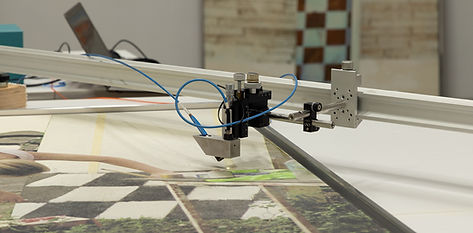
Understanding Effects of Light
At the Robert Rauschenberg Foundation, we used Microfade Testing (MFT) to evaluate the light sensitivities of several groups of pigment- and dye-based inkjet transfer works
Conservation Treatment Portfolio
Recent work from the Philadelphia Art Museum (2022-2023) and the Walters Art Museum (2023-Present)
More coming soon!

Fly
Earthenware with luster & metallic overglaze decorations. 1982. Lizbeth Stewart. Philadelphia Museum of Art.
Complex structural repair.

Brillo Boxes
Wood, ink. Andy Warhol. Philadelphia Museum of Art.
Loss compensation using toned Japanese paper.

Peony Plant
Green nephrite, amethyst, quartz or agate, carnelian or sard, turquoise, jade, glass beads, cinnabar lacquer, wood, ferrous and non-ferrous metal wires, dyed silk threads, hide glue (est.). Early 19th c. Unknown Chinese artist. Philadelphia Museum of Art.
Surface cleaning and creating cast Paraloid B72 fills for losses in semi-precious stones.

Tiffany Coffee Pot
Silver, enamel, elephant ivory. c. 1884. Tiffany and Company. Walters Art Museum.
Dramatic polishing of tenacious, dark tarnish.

Standing Figure of Susan MacDowell Eakins
Plaster, paint. 1894. Samuel Murray. Philadelphia Museum of Art
Complex loss compensation using a mold.

Islamic Plate
Fritware, green and white underglaze decoration, transparent glaze. 2nd half of the 13th c. Iran. Walters Art Museum.
Overpaint removal, loss compensation.

Nereid Reclining on a Wave
Carved marble, 1909. Hans Schuler. Walters Art Museum.
Surface cleaning marble.

Marquetry Panel
Various woods, copper alloy, and elephant ivory on a wood panel with gilded copper alloy frame. 1874-1876. Rosalie-Eléonore-Antoinette Duvinage/ Maison Alphonse Giroux. Philadelphia Museum of Art.
Loss compensation using toned Japanese paper.

Goblet
Philadelphia Museum of Art.
Removal of old fills, loss compensation.

Deep Dessert Plate
Hard paste porcelain, lead glaze, printed, enamel, and gilded decoration. c. 1817-1820. The partnership of Dagoty and Honoré. Philadelphia Museum of Art.